
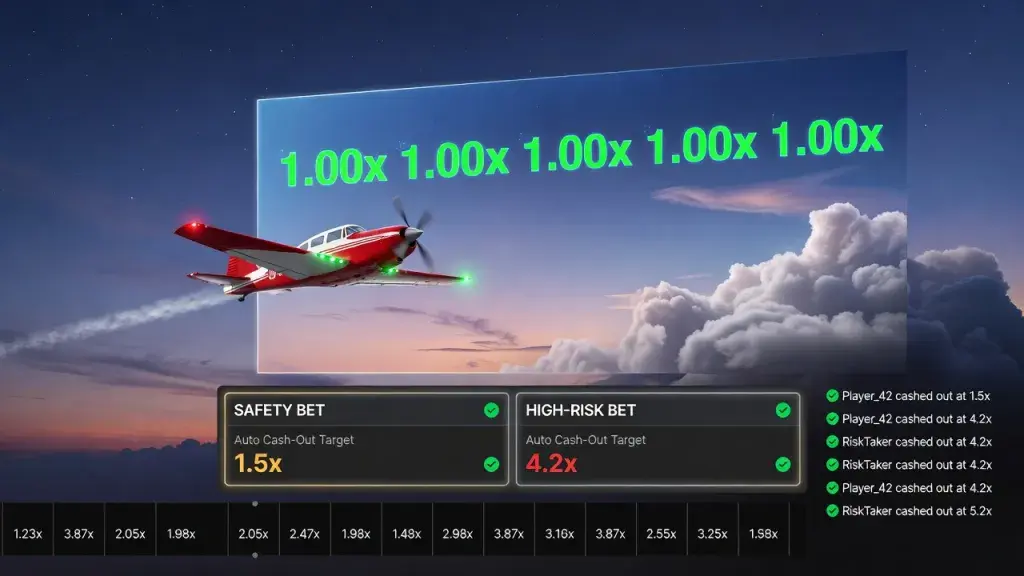
A plane takes off from the left edge of the screen, a multiplier climbs from 1.00x, and somewhere between two and thirty seconds later it disappears. That's the entire premise. No cards, no reels, no dealer - just a curve rising until it doesn't. Yet this stripped-down format has pulled in millions of players across dozens of betting platforms, and the reason isn't mystery or luck alone. It's a payout structure built on visible, real-time risk that forces a decision every single second the round runs.
Understanding why this works requires looking past the animation and into the mechanics underneath. Every round is generated by an algorithm that determines a crash point in advance, though nobody - not even the operator, in properly certified versions - knows that number until it hits. Before placing real money on the line, it's worth reading through the official aviator game rules to see how the round generation, fairness verification, and cash-out windows are documented by the platform itself. That single step separates players who understand what they're betting on from those who are simply reacting to colors and sounds.
This piece breaks down how the game actually functions, what governs payouts, and which betting approaches hold up under scrutiny versus which ones just feel convincing in the moment.
What Is the Aviator Game and Why It Became So Popular
Aviator belongs to a category commonly called crash games - a genre where a value increases continuously and players must exit before it resets to zero. The format originated from earlier crypto-based crash games and was refined into a polished, licensed product with a plane visual and social betting feed. Its popularity stems from three things: the round length is short, the decision is binary, and the potential multiplier is uncapped in theory, which creates a tension no slot reel replicates.
Origins of the Crash Game Genre
Crash mechanics first appeared in unregulated crypto gambling circles, where transparency was the selling point - players could verify that outcomes weren't manipulated after the fact. Aviator adapted that transparent-outcome concept into a regulated, casino-style product, adding a shared betting room where other players' cash-outs are visible in real time.
Why Players Are Drawn to Fast-Paced Betting
Round duration rarely exceeds a minute, and most crash well under ten seconds. That pace means dozens of rounds per hour, far more than a typical table game, which keeps engagement high and losses (or wins) compounding quickly. The instant feedback loop - bet, watch, cash out or lose - is part of what makes the format both appealing and risky.
Core Aviator Game Rules Explained
Before any strategy matters, the mechanical rules need to be clear. Aviator runs on a provably fair random number generator that sets the crash multiplier before the round begins. Players place a bet during the betting window, then must manually (or automatically) cash out before the plane flies off.
How the Multiplier Works
The multiplier starts at 1.00x and increases continuously, typically accelerating the longer the round runs. If a player cashes out at 2.50x, their stake is multiplied by 2.5. If the plane crashes before they cash out, the entire bet is lost. There is no partial payout for waiting too long.
Round Structure and Betting Windows
Each round follows a fixed sequence: a betting phase of several seconds, the flight phase where the multiplier climbs, and the crash moment. Most platforms allow bets to be placed right up until the flight phase begins, and many permit two simultaneous bets per round, each with independent cash-out settings.
Provably Fair Verification
Reputable operators publish a hash before the round starts and reveal the seed afterward, letting players independently confirm the crash point wasn't altered. This verification system is the backbone of trust in the genre, since there's no visible dealer or physical mechanism to inspect.
How to Play Aviator Step by Step
Getting started takes under a minute, but understanding the interface fully takes longer. This section walks through the practical mechanics from account setup to your first cash-out.
Setting Up Your Bet Amount
Players select a stake using preset buttons or manual entry, typically with a minimum bet around the platform's lowest denomination and no fixed maximum beyond account limits. Setting two separate bet panels lets players run one conservative and one aggressive strategy simultaneously.
Using Auto Cash-Out Settings
Auto cash-out lets a player pre-set a multiplier target - say 1.8x - so the system exits automatically without requiring a manual click. This removes the emotional hesitation that causes many players to hold out for "just a bit more" and then lose everything.
Reading the Live Multiplier and Round History
The interface displays a history bar showing recent crash points, which some players use to spot patterns. These patterns are statistically meaningless since each round is independent, but the history bar remains useful for gauging recent volatility and adjusting bet sizing accordingly.
Aviator Betting Rules You Need to Know
Beyond the basic mechanics, every platform enforces specific betting rules that shape how much control players actually have during a round.
Minimum and Maximum Bet Limits
Most platforms set a low minimum bet to encourage frequent play, alongside a maximum that scales with account verification level. High-roller limits are usually available only after identity verification is completed.
Double Betting and Simultaneous Wagers
The dual-bet panel is a defining feature of aviator betting rules. It allows a player to hedge - for example, cashing out one bet early for a guaranteed small win while letting the second ride for a bigger multiplier.
Cash-Out Timing Restrictions
Cash-out requests are processed in real time, but on a slow connection there's a real risk of the crash happening before the request registers. This latency risk is rarely discussed but matters enormously at higher multipliers where seconds determine the entire outcome.
- Bets must be placed before the flight phase starts - no late entries mid-round.
- Auto cash-out settings lock in once the round begins and cannot be adjusted mid-flight.
- Some platforms cap the maximum multiplier per round, though this ceiling is rarely reached.
Crash Game Payout Rules and RTP Explained
Payout mechanics in Aviator differ from slots or table games because the return is entirely tied to timing rather than a fixed paytable. Understanding the underlying return-to-player rate clarifies why the house maintains an edge despite the apparent simplicity.
How RTP Applies to Crash Games
Aviator's published RTP typically sits in the high 90s percentage range, meaning that over a large number of rounds, the game returns that percentage of wagered money to players collectively. The remaining percentage is the house edge, distributed across all outcomes rather than concentrated in rare jackpot events.
Why the House Edge Increases at Higher Multipliers
The probability of the plane reaching a high multiplier drops sharply the longer a round runs, since the underlying algorithm weights crash points toward lower values. This means chasing 10x or 50x multipliers carries dramatically lower odds than cashing out at 1.5x or 2x, even though the visible interface treats every multiplier as reachable.
Reading Payout Curves and Risk Distribution
Some platforms publish a payout distribution chart showing the frequency of past crash points across a large sample. These charts consistently show a cluster of crashes below 2x, with a rapidly thinning tail toward higher multipliers - a pattern typical of exponential-decay probability curves used in crash game payout rules.
Effective Aviator Strategy for Consistent Play
No strategy eliminates the house edge, but disciplined approaches reduce variance and protect a bankroll from rapid depletion. The strategies below are commonly used by experienced players, each with distinct tradeoffs.
Low-Risk Cash-Out Strategy
This approach targets small, frequent wins by cashing out consistently between 1.2x and 1.5x. It produces a higher win rate but smaller individual payouts, suited to players prioritizing bankroll longevity over big multipliers.
Martingale-Style Bankroll Management
Doubling the bet after each loss, aiming to recover previous losses with a single win, is a classic approach borrowed from roulette systems. It carries serious risk: a short losing streak can exhaust a bankroll faster than the recovery math suggests, especially given betting limits that cap how many times a bet can be doubled.
Split-Bet Hedging Technique
Using the dual-bet panel, a player might set one bet to auto cash-out at 1.3x for a safety net and let the second run manually toward a higher target. This balances guaranteed small returns against the possibility of a larger multiplier hit.
Setting Loss Limits and Session Boundaries
The single most reliable tactic isn't a betting pattern at all - it's a hard stop. Deciding in advance on a maximum session loss and walking away when it's hit prevents the emotional escalation that turns a manageable loss into a significant one.
Common Mistakes Players Make in Aviator
Even players who understand the rules thoroughly fall into predictable traps once real money and adrenaline enter the picture.
Chasing Losses After a Crash
Increasing bet size immediately after a loss, hoping to recover in one round, is the fastest way to drain a bankroll. The multiplier has no memory of previous rounds, so there's no statistical justification for escalating stakes based on recent history.
Ignoring Bankroll Percentage Rules
Betting a large share of total funds on a single round removes the margin needed to recover from a bad run. A common guideline among disciplined players is capping any single bet at a small fixed percentage of total bankroll, rarely above five percent.
Over-Relying on Auto Cash-Out Without Adjusting Strategy
Auto cash-out is useful for discipline, but setting it once and never revisiting the target ignores how bankroll size and session goals shift over time. A fixed 2x target might make sense early in a session and be far too aggressive after a string of losses.
Frequently Asked Questions
Is Aviator a game of skill or pure chance?
It's overwhelmingly chance-based. The crash point is generated randomly before the round starts, so no amount of observation or pattern-reading changes the underlying probability. Skill only enters through bankroll management and cash-out discipline, not through predicting outcomes.
Can I predict when the plane will crash?
No. Each round is independently generated, and the visible round history has no bearing on future outcomes. Any strategy claiming to predict crash points based on past rounds is not grounded in how the algorithm actually functions.
What's a realistic multiplier target for regular players?
Most experienced players aim for the 1.5x to 2.5x range, since crash frequency data shows the majority of rounds end before 2x. Targeting higher multipliers consistently increases variance and the likelihood of losing streaks.
Does bet size affect the crash point?
No. The multiplier is generated independently of how much any player wagers, and the outcome is identical whether one player or a thousand are betting in that round. The randomization is tied to the round itself, not to individual stakes.
Is it better to play manually or use auto cash-out?
Auto cash-out removes emotional decision-making and enforces the exact exit point you set in advance, which tends to produce more consistent results over time. Manual play offers flexibility to react to a specific round but carries higher risk of hesitation-driven losses.
How much should I bet per round as a beginner?
A cautious starting point is betting no more than two to five percent of your total session bankroll per round. This keeps a losing streak from wiping out funds quickly while still allowing enough rounds to understand how the multiplier behaves.